
Introduction to Cover Trades: Unpacking the Meaning
Navigating the fast-paced world of financial markets demands more than intuition—it requires a solid grasp of specialized strategies and terminology. Among these, the concept of a *cover trade* stands out as a critical mechanism, particularly for traders engaging in short selling. At its heart, a cover trade is the action taken to close an open short position, whether to lock in gains or prevent further losses. While it may sound like a simple transaction, the reality is more nuanced. It encompasses key practices such as “buy to cover” and the use of “cover orders,” each serving distinct strategic purposes. These tools aren’t just technicalities—they’re essential components of disciplined trading, allowing investors to manage exposure and respond effectively to market shifts. In this deep dive, we’ll explore the mechanics, applications, and strategic importance of cover trades, shedding light on how they shape real-world trading decisions.
What Does “Buy to Cover” Mean?

One of the most essential actions in short selling is the “buy to cover” transaction. This isn’t just a standard purchase—it’s the deliberate move to close a short position by repurchasing shares that were previously sold short. When a trader believes a stock is overvalued, they can borrow shares and sell them at the current market price, hoping to buy them back later at a lower cost. The act of buying those shares to return them to the lender is what’s known as “buy to cover.”
For example, imagine a trader borrows 100 shares of a company trading at $50 and sells them, receiving $5,000. If the stock drops to $40, the trader can buy back the shares for $4,000, return them, and pocket a $1,000 gross profit (minus fees). But if the price rises instead, the same “buy to cover” move becomes a tool for damage control, allowing the trader to exit before losses grow too large. This flexibility makes “buy to cover” a cornerstone of short-selling strategy—not just a step, but a pivotal decision point.
The Lifecycle of a Short Sell and Buy to Cover
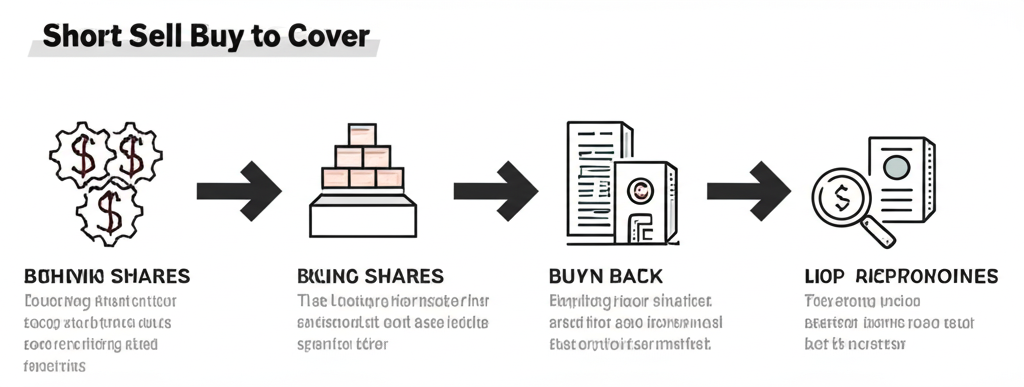
The journey from opening a short position to closing it through a “buy to cover” transaction follows a clear sequence of steps:
- Borrowing Shares: The process begins when a trader identifies a stock they expect to decline. They borrow shares through their brokerage, which acts as an intermediary with lenders, often institutional investors or other clients.
- Selling Borrowed Shares: Once borrowed, the shares are immediately sold on the open market. The proceeds are held in the trader’s account, but the obligation to return the shares remains.
- Monitoring Price Movement: The trader watches the stock closely, waiting for price movement that aligns with their prediction. The ideal scenario is a steady decline, but volatility can quickly change the outlook.
- Buying to Cover: When the time is right—whether the price has dropped or risen unexpectedly—the trader buys the same number of shares back. This is the “buy to cover” action, the key to closing the loop.
- Returning Shares: The newly purchased shares are delivered back to the lender, fulfilling the borrowing agreement and eliminating the short obligation.
- Profit/Loss Realization: The difference between the initial sale price and the repurchase price determines the outcome. If bought back cheaper, the trader profits; if more expensive, they incur a loss.
This cycle highlights that “buy to cover” is not merely a transaction—it’s the final, necessary step in a contractual and financial commitment. Without it, the short position remains open and exposed to ongoing market risk.
Understanding Cover Orders: A Trader’s Safety Net
While “buy to cover” is the action that closes a position, a *cover order* is a strategic tool designed to automate and enforce that action under specific conditions. A cover order is a bundled instruction submitted to a brokerage that pairs an entry order—such as a short sale—with a mandatory stop-loss order. The primary purpose? To cap risk from the very beginning of a trade.
Cover orders are especially popular in intraday trading, where rapid price swings can turn a profitable setup into a major loss in minutes. By requiring a stop-loss to be set at the time of entry, the system ensures that no trade goes unguarded. For short sellers, this means peace of mind: even if the market moves sharply against them, the position will be closed automatically once the stop price is hit.
Components of a Cover Order
A well-structured cover order is built on two interconnected parts:
- Initial Market or Limit Order: This is the trade entry—either a “sell short” or, less commonly, a “buy” for long positions. The trader specifies the price and quantity, just like a regular order.
- Compulsory Stop-Loss Order: This is the safety mechanism. For a short position, it’s a “buy to cover” order set at a price above the entry point. For instance, if a stock is shorted at $100, the stop-loss might be placed at $103. If the price hits that level, the position is automatically closed, limiting the loss to $3 per share.
Unlike regular stop-loss orders, which can be modified or canceled independently, the stop-loss in a cover order is locked in. This enforced discipline helps traders avoid emotional decisions and maintain consistency in their risk management.
How to Place a Cover Order (Conceptual)
From a practical standpoint, placing a cover order is straightforward on most modern trading platforms. Here’s how it typically works:
- Select the “Cover Order” option in your trading interface.
- Enter the stock symbol, quantity, and desired entry price—or choose a market order for immediate execution.
- Set the stop-loss trigger price, which defines your maximum acceptable loss.
- Review the order details, including the potential downside and the execution logic.
- Confirm and submit the order.
Once placed, the system activates both the entry and stop-loss components. If the market moves against you, the stop-loss kicks in automatically, triggering a “buy to cover” transaction to close the position. This automation is especially valuable in fast-moving or after-hours markets, where manual intervention might be too slow.
Why Are Cover Trades Essential for Traders?
Cover trades are far more than routine closures—they’re strategic instruments that protect capital and shape trading behavior. Their importance cannot be overstated, particularly in high-risk strategies like short selling. Here’s why:
* **Risk Management:** Short selling is inherently risky. Unlike buying a stock, where the maximum loss is limited to the purchase price, a short position has theoretically unlimited downside. A “buy to cover” action—whether manual or automated—is the only way to stop the bleeding when a trade goes wrong. Cover orders amplify this protection by baking risk limits into the trade from the start. According to the Financial Industry Regulatory Authority (FINRA), understanding margin accounts and the risks of short selling is a critical responsibility for investors Source 1.
* **Profit Realization:** A successful short trade isn’t truly successful until it’s covered. Until then, profits are just on paper. By executing a “buy to cover,” traders convert potential gains into realized returns, securing their results.
* **Regulatory and Operational Compliance:** Brokers may issue margin calls if a short position moves too far against the trader, demanding additional funds or requiring the position to be closed. In some markets, intraday short positions must be squared off before the market closes. Cover trades ensure compliance with these rules.
* **Strategic Flexibility:** Markets evolve, and so should trading positions. If new information emerges or the original thesis weakens, covering a short allows traders to exit cleanly and redeploy capital elsewhere. It’s a key part of adaptive, agile trading.
Buy to Cover vs. Cover Order: Key Distinctions
Though often discussed together, “buy to cover” and “cover order” serve different roles in a trader’s toolkit. Understanding the distinction is essential for effective strategy.
| Feature | Buy to Cover | Cover Order |
| :————– | :————————————————– | :———————————————————— |
| **Definition** | The *action* of purchasing shares to close an open short position. | A *specific order type* that combines an entry order with a mandatory stop-loss. |
| **Scope** | Applies to *any* short position, regardless of how it was initiated. | A structured *method* of entering a trade with enforced risk control. |
| **Timing** | Can be executed at any point—during intraday, swing, or long-term trades. | Most commonly used in intraday or short-term trading environments. |
| **Risk Control** | The *result* of risk management (e.g., manually covering a losing position). | An *in-built mechanism* that enforces risk limits from the outset. |
| **Purpose** | To fulfill the obligation to return borrowed shares and realize profit or loss. | To ensure every trade has a predefined exit strategy, minimizing emotional decision-making. |
In essence, “buy to cover” is the transaction that ends a short position. A cover order is a smarter way to enter a trade with that exit already planned. Every triggered cover order results in a “buy to cover,” but not every “buy to cover” comes from a cover order.
Strategic Considerations and Common Pitfalls
Mastering cover trades goes beyond knowing how they work—it requires navigating real-world complexities and avoiding costly mistakes.
* **Timing and Market Conditions:** Knowing *when* to cover is one of the hardest decisions. Closing too early means leaving money on the table; waiting too long can turn a small loss into a major one. In volatile markets, sudden news or momentum shifts can trigger stop-losses prematurely, leading to “whipsaw” losses.
* **Liquidity Challenges:** A “buy to cover” order relies on market depth. In illiquid stocks, there may not be enough sellers at the desired price, forcing the trader to pay more. This slippage can erode profits or inflate losses, especially during rapid price movements.
* **Short Squeeze Risk:** This is every short seller’s worst fear. A short squeeze happens when a stock’s price spikes unexpectedly, triggering a wave of forced “buy to cover” transactions. As more short sellers rush to exit, their collective buying pressure drives the price even higher, creating a feedback loop. Events like positive earnings surprises, short-term squeezes like the GameStop incident, or even rumors can ignite this chain reaction. For deeper insights into how short squeezes unfold, Investopedia offers a detailed analysis Source 2.
* **Common Misunderstandings:** One major confusion is equating “buy to cover” with a regular buy order. While both involve purchasing shares, their intent is opposite: a standard buy opens or adds to a long position, while “buy to cover” closes a short. Another misconception is assuming a stop-loss guarantees execution at the exact price. In fast markets, orders may fill at worse prices due to slippage, especially with large orders or low-volume stocks.
Advanced Scenarios and Related Concepts
While cover trades are most commonly associated with equities, the principle of “covering” extends across financial markets. In options trading, for instance, a “covered call” strategy involves selling a call option while holding the underlying stock—this “covers” the obligation if the option is exercised. Similarly, in futures markets, a trader might offset a short futures contract by buying an equivalent long contract, effectively “covering” the position.
These variations share the same core idea: reducing or eliminating exposure to risk. Cover trades are also part of broader risk management systems that include trailing stops, bracket orders, and position sizing. When integrated thoughtfully, they help traders maintain control, preserve capital, and avoid catastrophic outcomes. Whether you’re managing a single short position or a diversified portfolio, understanding how and when to cover is a skill that separates disciplined traders from speculative gamblers.
Conclusion: Mastering the Art of the Cover Trade
The ability to execute effective cover trades is a hallmark of skilled, responsible trading. Whether through the straightforward “buy to cover” or the protective structure of a cover order, these mechanisms are vital for managing risk, locking in profits, and maintaining control in unpredictable markets. Short selling offers powerful opportunities, but it comes with significant dangers—unlimited losses, margin calls, and the ever-present threat of a short squeeze. Cover trades are the tools that keep those risks in check.
True mastery lies not just in knowing the mechanics, but in applying them with discipline, timing, and strategic foresight. For traders serious about long-term success, understanding cover trades isn’t optional—it’s foundational. It’s the difference between reacting to chaos and managing risk with precision.
What is the primary purpose of a cover trade in stock market?
The primary purpose of a cover trade is to close an open short position. This action allows traders to either realize profits if the stock price has fallen, or to limit losses if the stock price has risen against their short position. It fulfills the obligation to return borrowed shares.
How does “buy to cover” differ from a standard “buy” order?
A standard “buy” order is typically used to initiate or add to a long position, meaning you are purchasing shares with the expectation that their value will increase. “Buy to cover,” on the other hand, is specifically used to close out a previously opened short position, returning borrowed shares to the lender. It’s an obligation fulfillment rather than a new investment.
Can I place a cover order for long-term investments, or is it only for intraday trading?
While the term “cover order” with its mandatory stop-loss is most commonly associated with intraday trading due to its focus on immediate risk control, the underlying principle of using a stop-loss to manage risk on a short position can be applied to longer-term trades. However, a specific “cover order” as an integrated order type is more prevalent in short-term, high-frequency trading platforms. For longer-term short positions, traders would typically use separate stop-loss buy orders.
What are the risks associated with not covering a short position?
Not covering a short position carries significant risks, primarily unlimited potential losses. Since a stock’s price can theoretically rise indefinitely, an uncovered short position could lead to losses far exceeding the initial investment. Other risks include margin calls (requiring you to deposit more capital), borrowing fees that accrue over time, and the risk of a short squeeze, where a rapid price increase forces short sellers to cover at escalating prices.
What happens if the market moves against me after placing a cover order?
If the market moves against your short position after placing a cover order, your compulsory stop-loss component will automatically trigger a “buy to cover” order once the stock price reaches your predefined stop-loss level. This action closes your position, limiting your losses to the amount you set. In highly volatile markets, there might be some “slippage,” meaning the order executes at a price slightly worse than your stop price, but it still prevents unlimited losses.
Is a “cover order” the same as a “stop-loss order”?
No, they are related but not identical. A “stop-loss order” is a general type of order used to limit losses on any position (long or short). A “cover order” is a specific *combination* order type that includes an initial market/limit order and a *mandatory* stop-loss order. The key difference is that the stop-loss in a cover order is compulsory and integrated from the moment the trade is initiated, often for intraday short selling.
What is the relationship between short selling and buying to cover?
Short selling and buying to cover are two integral and sequential parts of the same trading strategy. Short selling is the act of opening a position by borrowing and selling shares, anticipating a price drop. Buying to cover is the necessary act of closing that position by purchasing shares to return to the lender. One cannot exist without the other in a complete short-selling cycle.
How does market liquidity affect the execution of a cover trade?
Market liquidity significantly impacts the execution of a cover trade. In highly liquid markets, a “buy to cover” order (especially a stop-loss) is likely to be filled quickly and close to the desired price. In illiquid markets, however, there may not be enough buyers available at the desired price, leading to “slippage.” This means your order might be executed at a less favorable price, potentially increasing your losses or reducing your profits.
Can a cover trade be used for assets other than stocks, like options or futures?
While the term “buy to cover” is most directly associated with closing short stock positions, the underlying concept of “covering” a position to mitigate risk applies broadly across various asset classes. For options, one might “cover” a short call option by owning the underlying stock (a covered call). In futures, a trader might “cover” a short futures contract by buying an equivalent long contract. The specific terminology and mechanics might differ, but the principle of offsetting or closing an open, risky position remains the same.
What is a “short squeeze” and how does it relate to cover trades?
A short squeeze occurs when a stock’s price rapidly increases, forcing short sellers (who bet on a price decline) to “buy to cover” their positions to avoid massive losses. This sudden, forced buying activity further drives up the stock price, creating a self-reinforcing upward spiral. Short squeezes are a significant risk for short sellers and highlight the critical importance of timely cover trades and robust risk management strategies.